EEvidenced · Belegter Fakt. Quelle vorhanden, verifizierbar.IInterpretation · Unsere Deutung belegter Daten. Andere Lesarten möglich.JJudgment · Einschätzung auf Basis von Erfahrung und Mustern. Kann falsch sein.AAssumption · Not evidenced, but necessary for the analysis.
In 2020, eight candidates ran for mayor of Bamberg. The SPD incumbent Andreas Starke led the first round with 35.9%, ahead of the Green candidate Jonas Glüsenkamp at 24.6%.E Starke won the runoff with 59.3%.E An SPD mayor, re-elected in a state where the SPD polls at 8.4%.E
How is that possible? The answer isn't the SPD's strength. It's the structure of the election itself.I When eight candidates run, even 36% leads to a runoff. And in a runoff, different rules apply: it's not the party that matters, it's the person.I
The Pattern: In fragmented fields, every lead melts. In 2020, roughly 750 Bavarian mayoral races went to a runoff, including 5 of the largest cities.E The trend is clearly heading toward more runoffs as candidate fields grow.I
● The Cities at a Glance
On March 8, 2026, major Bavarian cities will simultaneously elect new mayors.E We analyzed 10+ cities using data-driven methods, with 30+ public sources each.
Interactive analysis with scenario simulation, voter flow projection, and candidate comparison for all cities available on request. Request access →
● Three Patterns That Explain Everything
1. Fragmentation forces runoffs. The more candidates, the less likely an absolute majority.I Regensburg has 12 candidates.E Even the strongest candidate will barely break 35%.J
2. The party matters less than the person. In 2020, the SPD incumbent won in Bamberg despite the SPD polling at 8.4% statewide.E In 2025, the first Green mayor in Bavaria was elected in Würzburg.E Local races follow different rules.I
3. No incumbent means anything goes. In Landshut, Regensburg, Bamberg, and Passau, the sitting mayors are not running again.E Historically, open seats lead to significantly tighter results.I
300+public sources analyzed across 10+ citiesE750runoffs in 2020, including the 5 largest Bavarian citiesE4 of 8cities in our dataset have open seats, no incumbent runningE
Sources: Bavarian State Office for Statistics, kommunalwahl2020.bayern.de, BR24, Augsburger Allgemeine
Political consultancies typically charge €20,000-50,000+ for municipal election analyses with comparable scope.J Our platform delivers automated, source-based analysis in 48 hours, continuously updatable. About us →
We're making our predictions public. We expect a runoff in at least 5 of 8 cities on March 22.J On election night at 8 PM, we'll compare results with our predictions live.
Is our analysis right, or did we get it wrong? In 11 days, we'll know.
Florian Ziesche
Founder, Ainary Ventures. Former CEO 36ZERO Vision (AI, Munich). Analyzing municipal elections with AI and 300+ sources.
High Demand · Limited Availability
● See the full analysis
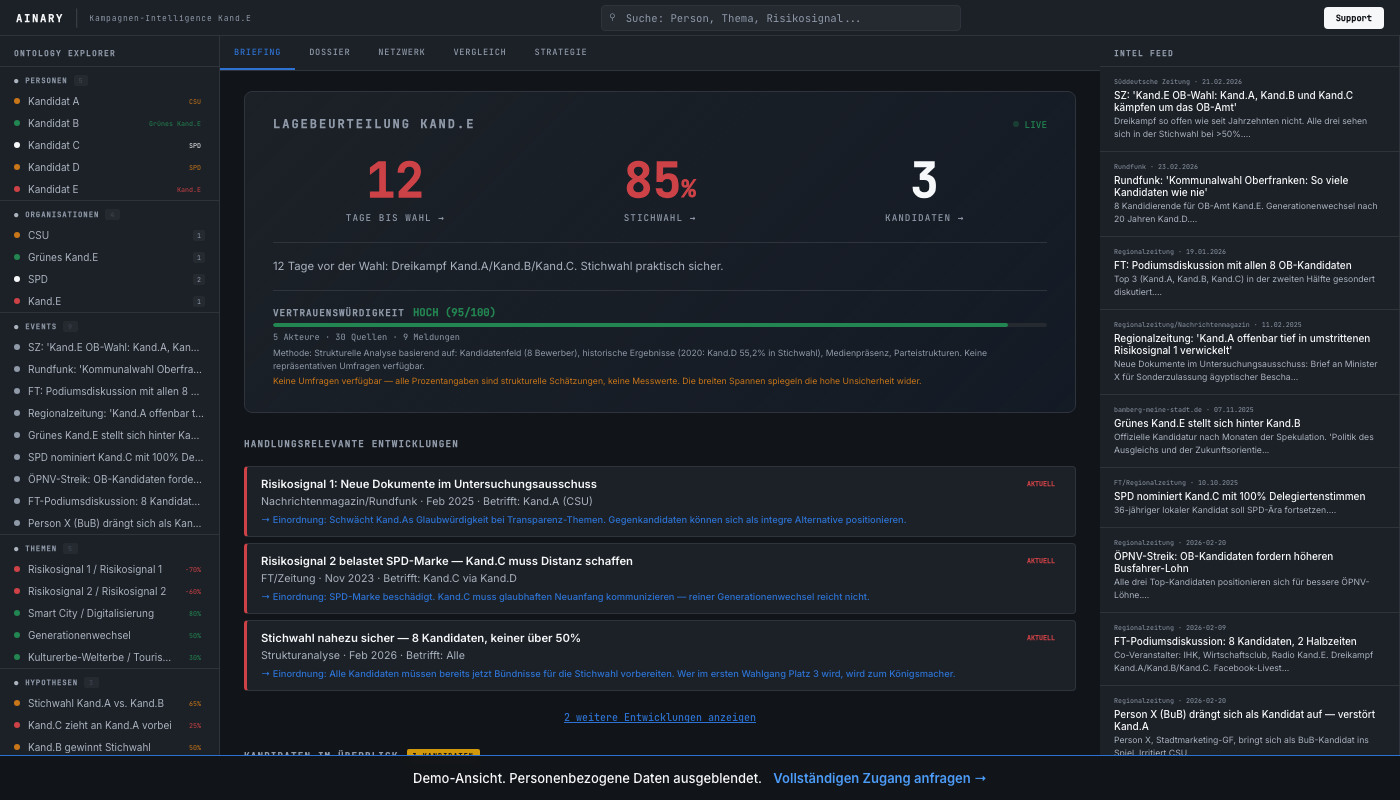
Every claim in this article is backed by our intelligence dashboard: candidate profiles, risk scores, source citations, and scenario simulations for every city.
Methodology: Structural estimation based on public sources. No polling data (unavailable for municipal elections). All assessments labeled using the EIJA system. Non-partisan.
30-60 public sources per city (news portals, YouTube, social media, Google Trends, council information systems, election archives) · Interactive scenario simulation · Automated source validation · Non-partisan, data-driven, transparent.
Get Results on March 8
We'll compare our predictions live with the results. One email, no spam.